You Already Know What Your Data Problems Are, But Can You Prove Them?
%20(23).png)
.jpg)
The data problems you have within your department are probably very apparent. However, the trouble usually lies when it comes to getting those data problems proven.
When asking a data product owner where their data is most at-risk; quite often we are given a list of systems, teams and a rough estimate as to when things started to deteriorate. The assumption is there, but whatever you need to show a finance department for support in resolving the issue most likely does not exist. This is an important difference. A concern stated without some form of evidence (supporting data) will sound similar to an opinion and opinions don't fare too well around budget meetings.
An old problem that hasn't gone away
In a 2019 National Audit Office report on the UK government's use of data, it was found that instead of using available assessment tools to evaluate the overall quality of the data collected by each department, new programs were created that highlighted existing issues. The report noted, "Good data is not a 'free good,'" therefore departments would need to invest resources in obtaining high-quality data on a systematic basis.
The State of Digital Government Review in 2025 also revealed this same picture. Even six years later, it required a significant amount of effort to find rudimentary information regarding risk, cost or service quality.
What working without data maturity assessment can cost you
The costs associated with the lack of evidence tend to become most visible during budget season. Typically money goes to either the person who is the most senior or the one yelling the loudest when there is no agreement regarding what is most important.
Another less obvious expense is repetition. Teams will continue to address symptoms while having little knowledge of the underlying cause. When a spreadsheet is cleaned-up because it had a reporting error, all parties involved move-on from the issue. Since the spreadsheet was never the root-cause of the original issue, the same reporting error is seen again in another report within a year. The NAO described this as a culture of tolerating workarounds. Each workaround carries a cost, and none of them appear in anyone's plan.
Furthermore, there is a lasting impact on how data initiatives are regarded. When proposing investments, business cases built on hard statistics consistently outperform those based purely on conjecture. Data refinement often ends up labeled as a cost to be minimised, rather than being recognised as the foundation that enables success elsewhere.
What our data maturity baseline assessment covers
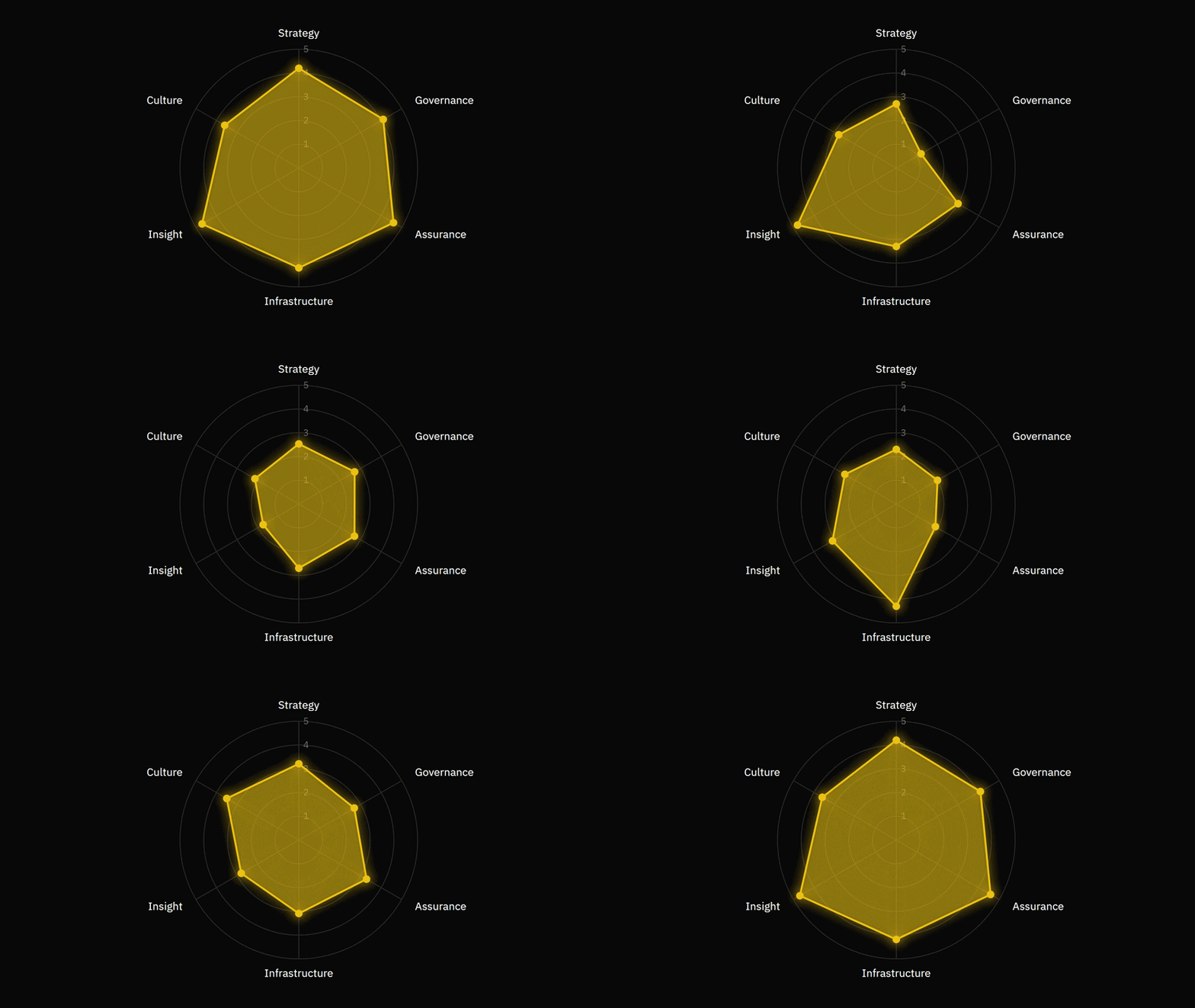
We evaluate six core categories to determine data maturity and identify gaps for improvement.
Strategy
Has your leadership team defined their requirements for organisational information, aligning them directly to strategic goals? A strategy tucked away in an unread file yields little value. Without clear direction, enhancements merely address the most recent issue rather than the highest priority.
Governance
Which team maintains ownership for individual datasets, and who holds responsibility for approving modifications? A surprising number of technical complications stem directly from unsettled questions of functional ownership.
Assurance
Do staff members possess trust in available records? This requires evaluating consistency, accuracy, and overall data health across disparate platforms. Many public sector organisations suspect their information is faulty without grasping the true severity or precise locations.
Infrastructure
Understanding where information is stored, how it flows, where copies reside, and where it remains trapped inside legacy systems. While this proves the most costly area to remediate, mapping these flows presents the strongest justification for funding.
Insight
Are employees receiving timely analytical support, or does generating basic reports require manual labour? This is where the overall impact of your broader data ecosystem becomes apparent.
Culture
Frequently overlooked yet extremely challenging to evaluate. Do leaders feel confident making choices using current reports, or do they rely on unofficial workarounds? Do staff have sufficient training to resolve errors, or are problems left unaddressed?
Why operational team members should be involved in a data maturity assessment
Baseline data maturity assessments regularly reveal a disconnect between how senior management perceives operations and what happens on the ground. Executives review polished dashboards. Meanwhile, staff manage the underlying friction: manual data entry, external spreadsheets, and redundant verification routines created to bypass unreliable tools.
Comparing these perspectives side-by-side uncovers valuable insights. It exposes hidden operational bottlenecks alongside misplaced confidence in current systems.
The impact of data maturity baseline reporting
Debates steadily shift away from vague complaints regarding information quality and you gain the ability to highlight high-risk areas and direct funding where it yields maximum return.
It also delivers objective findings that finance departments or committees can endorse. The structured evidence carries far more weight during budget reviews than subjective opinions, ensuring trade-offs are evaluated openly.
Additionally, it creates a defensible starting point for tracking performance. Ongoing data improvements take time, particularly in complex environments like public services, so demonstrating tangible, incremental progress is essential for securing long-term funding.
Considerations for new data managers and leadership
If you are recently appointed to lead data functions, establishing a data maturity baseline proves invaluable. Your initial months offer a unique window to ask difficult questions, providing objective data that belongs to your strategy rather than inherited legacy issues.
Starting small without a major overhead
Our complimentary online Data Maturity Assessment takes under ten minutes to complete, highlighting organisational strengths alongside vulnerable areas. Whilst it is not exhaustive, it delivers actionable evidence to spark initial conversations.
Complete the Data Maturity Assessment here.
Frequently asked questions
What is a data maturity assessment?
A data maturity assessment is a structured review of how well an organisation manages and uses its data. It measures current capability across areas such as strategy, governance and culture, giving a clear baseline of strengths and weaknesses that can be used to prioritise improvements and support funding decisions.
Why do public sector organisations need a data maturity baseline?
A data maturity baseline turns known data problems into evidence that finance teams and boards can act on. Without it, concerns about data quality tend to sound like opinions, and funding often goes to the most senior or loudest voice rather than the area with the greatest need.
What does it cost to work without evidence of data maturity?
Working without evidence leads to poorly targeted budgets, repeated fixes and undervalued data work. Teams treat symptoms rather than root causes, so the same errors return, and manual workarounds build up as hidden costs. Data improvement is also more likely to be seen as a cost rather than an enabler.
Why should operational staff be involved in a data maturity assessment?
Operational staff should be involved because they see how data really works day to day. Senior leaders usually see finished dashboards, while frontline teams deal with manual re-keying, extra spreadsheets and repeated checks. Comparing both views exposes hidden problems and misplaced confidence that a leadership-only assessment would miss.
How does a data maturity baseline help secure funding?
A data maturity baseline gives decision makers structured, objective evidence instead of subjective opinion. It highlights the highest-risk areas so funding can go where it has the most impact, makes trade-offs visible, and creates a starting point for showing progress over time, which helps maintain long-term investment.
How long does the Butterfly Data Maturity Assessment take?
The Butterfly Data online Data Maturity Assessment takes under ten minutes and is free to complete. It gives a tailored view of your organisation's data strengths and weaker areas. It isn't a full audit, but it provides a practical starting point for conversations about data improvement.
Ready to transform your data?
Book your free discovery call and find out how our bespoke data services and solutions could help you uncover untapped potential and maximise ROI.